
9/10
I’m obligated to point out that this is the first album I ever listened to. If my objectivity is in doubt at any point, just know that it’s because Demon Days and the band (?) behind it shaped my childhood in many ways.
Do Gorillaz really exist? The question doesn’t matter anymore — they’ve become as real as any other band. A group of cartoon characters have gone on to become one of the most critically- and commercially-acclaimed bands in British history.
Blur frontman Damon Albarn met the comic artist Jamie Hewlett (renowned for his Tank Girl series) in 1990. One day in 1998, whilst watching MTV, Albarn and Hewlett had a conversation about the artificial nature of late-90s pop music. They believed most artists and bands in the mainstream lacked any sort of depth. Albarn and Hewlett then came up with the idea to create a manufactured band, as a comment on acts like Backstreet Boys and NSync. But they wanted to make things interesting. Their own band would be virtual. Real and not real.
Gorillaz began that same year. Albarn and an array of guest musicians spent two years recording the tracks for the band’s debut album. At the same time, Hewlett created the visual universe that separates Gorillaz from almost every other musical act. The bandmates came into being as exaggerated caricatures: the everyman 2D, the ‘bad boy’ Murdoch, the cute child Noodle, and the hip-hop behemoth Russell.
Gorillaz (2001) introduced the band with thick-outlined comic book character designs and spray-painted titles. It was a moderate critical success and a commercial blockbuster, owing to modern classic songs like ‘Clint Eastwood’ and ‘Tomorrow Comes Today’. Gorillaz was an unexpected hit. However, the album lacked cohesion, feeling more like a collection of ideas than a unified album. The quality of the songs varies. But Gorillaz highlights one of the band’s strengths — Albarn’s willingness to explore different genres and collaborate with a dizzying number of renowned musicians. Gorillaz veers into trip-hop, hip-hop, ska, funk, and Latin territory.
You cannot pin Gorillaz down. You never could.
In the few years following their debut, a planned Gorillaz movie failed to materialise, and Blur recorded and released Think Tank (2003). Albarn and Hewlett eventually returned to Gorillaz. This decision meant that the virtual band was ‘no longer a gimmick’. Gorillaz would be here to stay.
After writing new music and gathering their guest musicians, they recorded between 2004-2005. The result was Gorillaz’ magnum opus.
‘In these demon days we’re so cold inside / It’s so hard for a good soul to survive …’
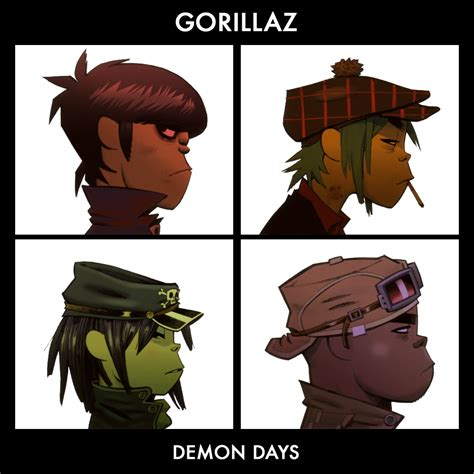
Demon Days (2005) presents a much darker world than the band’s debut. This is immediately clear: gone are the cartoonish street art elements of Gorillaz’ first phase. The bandmates no longer look like comic book characters — more graphic novelesque, maybe. The darkness isn’t just visual in Demon Days. It is abundantly clear in the music. Especially the lyrics. It is an apocalyptic album. It has a distinct post 9/11 feeling. Albarn meant to convey ‘the world in a state of night’. If you’ve heard the album or seen any of its music videos, then you know that he succeeded. The end-of-the-world concept guides the album. Demon Days has the musical and visual unity that Gorillaz lacked.
Why did Albarn take the band in this direction? How does it shine through in the music?
The beating heart of Demon Days is Danger Mouse. Albarn recruited the American producer in 2004, after his infamous Jay-Z / Beatles mashup The Grey Album, and only two years before he achieved worldwide stardom with CeeLo Green. (They formed Gnarls Barkley.) Danger Mouse’s production is what makes Demon Days sound so rich and dense.
‘Intro’ is the album’s false opener. It’s a strange, unsettling prelude. It begins with a sample from the Dawn of the Dead (1971) accompanied by distant sirens and an increasingly discordant synth chord. A voice says: ‘You are now entering the harmonic realm.’ Then Demon Days really starts.
The drums on second track ‘Last Living Souls’ blow the album open. They explode into being, pulling the arcadey synth and gritty bass into an echoey expanse. The track’s mid-song guitar and piano bridge is the first of many brief musical detours on Demon Days. These detours always add to whatever song they’re featured on. It sounds glorious. ‘Are we the last living souls?’ Damon Albarn asks throughout the track. By the end, he realises that we are the last living souls. A perfect opener to an album about modern existential dread.
Third track ‘Kids With Guns’ is driven by a deep, resonant bass line. It complements Albarn’s voice almost directly. Albarn sings of children who are ‘mesmerised skeletons’ and gun wielders. The children’s voices come through in the chorus: ‘They’re turning us into monsters / Turning us into fire.’ War rages around them. They know no other world, no other life. They will perpetuate it. They in turn will traumatise their children. The cycle is endless. What are the children of Gaza going to grow up to do? The children in Ukraine? Sudan? The Congo? Despite the subject, the instrumental is catchy and purposely misleading. It’s an earworm.
‘O Green World’ is about the constant friction between industrial society and nature. It’s a battle that humanity, by default, cannot win. The voice of ‘O Green World’ pleads with nature not to ‘desert’ them. We are made of nature and nature is made of us, they insist. The natural world would do just fine without humanity. Yet we cannot survive without it. But we’re here, and we have an obligation to protect it. Something to consider in the climate of 2025. The rest of the song’s lyrics are extremely cryptic. The chorus anchors it. For a song about nature, there are industrial influences all over ‘O Green World’ — the bleeps and bloops, gritty bassline, the fuzzy-sounding scream before each chorus.
‘Dirty Harry’ is a contender for Demon Days’s funkiest song. It is also one of its darkest. The San Fernando Youth Choir sings throughout the track and repeats the phrase: ‘I need a gun.’ Perhaps these are the kids with guns. You cannot help but move to the catchy synth line and dense drum beat. Ominous strings soon put you on edge. There’s a guttural scream, the song breaks down, and Bootie Brown from the Pharcyde starts rapping. From a soldier’s first-person perspective, he conveys the personal existential horror of war — ‘…on constant alert from the constant hurt / That seems limitless with no drop in pressure…’ — and the fact that the global economy runs on blood and oil — ‘I’m the reason why you fill up your Isuzu.’ Our everyday life is dependent on horrors unfolding elsewhere in the world. We don’t often think about that when we’re filling up our cars at the garage. One of Demon Days‘s strongest highlights.
This may be blasphemy: ‘Feel Good Inc.’ is one of the album’s weaker songs. It’s a modern classic pop song and one of the most influential songs of the 2000s. And it’s a great song on its own. But in relation to the rest of the album, it feels quite weak. The only thing that prevents it from bringing down my rating of Demon Days is that it feels intentionally placed. It’s bouncy and energetic, but the lyrics are quite nonsensical and De La Soul’s verse is a bit exaggerated. What saves the song is its chorus. It is dreamy and ethereal, in contrast to its instrumental (which still has one of the catchiest basslines ever). The laughter throughout the song grows desperate at the end. It almost sounds like screaming and sobbing. That is understandable, given what comes next.
‘El Mañana’ is my favourite song on Demon Days. It couldn’t be any more different to ‘Feel Good Inc.’. This is a song about spiritual defeat in the face of the passage of time. Humanity’s endless struggle. The plaintive keyboards and simple drum pattern are enough to reduce you to tears. It is richly textured despite being the most pared back song on the album. Albarn sings with a sorrow that sounds like it will never lift. And ‘El Mañana’ has the best string arrangements on Demon Days. It’s the sort of song to make you despair over the state of the world. It’s cathartic. It must’ve been equally powerful upon release, post 9/11, and only a month before the 7/7 bombings in London.
The next three tracks — ‘Every Planet We Reach Is Dead’, ‘November Has Come’, and ‘All Alone’ are phenomenal. They provide uplift after the devastation of ‘El Mañana’. The pace of Demon Days slows a bit with the first two tracks I’ve mentioned, but ‘All Alone’ (my favourite of this trio) brings the energy back. Roots Manuva delivers a slice of great UK hip-hop, and Martina Topley-Bird responds with a dreamy verse that doesn’t seem out of place. ‘November Has Come’ also deserves recognition for its MF DOOM feature. He brings his usual serial rhyming style to an uplifting instrumental. ‘White Light’ is my least favourite track on Demon Days, but it’s the shortest, and I enjoy its Bloc Party-esque guitar riff.
‘DARE’ is the funkiest song on the album. Without question. You cannot listen to it without bobbing your head. It is almost a dance beat. The drums hit hard. ‘Jump with them all and move it / Jump back and forth…’ Shaun Ryder and Roses Gabor sing. It’s quite hard not to do that. Yet there’s something haunting about the song’s ethereal background piano line and echoey backing vocals. ‘It’s coming up … It’s dare.’ The song was initially meant to be called ‘It’s There’, but Shaun Ryder’s thick Mancunian accent makes ‘there’ sound like ‘dare’. What is coming up? What is there? The end of the world, no doubt. Our mistakes and collective violations against humanity (war, environmental destruction, neoliberalism) have caught up to us all. We’re feeling it. It’s here.
‘Fire Coming Out of the Monkey’s Head’ is a deeply unsettling tale and a very unusual song. Dennis Hopper narrates a hopeless story about ‘Happyfolk’ who live ‘at the foot of a great mountain’ called Monkey. ‘Strangefolk’ come into town one day and begin mining the mountain for its ‘jewels’. Then the mountain — a volcano — erupts and kills everyone, Happyfolk and Strangefolk alike. The Happyfolk didn’t deserve it. The obvious interpretation is that the song is a parable about human-led climate change. Coveting the earth’s natural resources will kill us all. But perhaps it’s about the search for oil in the Middle East, too: ‘And soon they began to mine the mountain, / Its rich seam fuelling the chaos of their own world.’ One could write an essay about the ecological themes of Demon Days. This track shouldn’t work, but it really does.
‘Don’t Get Lost In Heaven’ is another musically uplifting song. There is a consistent sense of balance in the sequencing of Demon Days. The album really benefits from it. But the instrumental of ‘Don’t Get Lost In Heaven’ consists of echoey vocals, piano, and strings. It is reminiscent of the Beach Boys. It’s brief and quite wispy, but it transitions perfectly into the final song — the title track.
‘Demon Days’ sounds like the sun rising. Strings ease us into it before Albarn sings in a falsetto, which is quite distant in the mix. Then the song becomes focused: the rest of ‘Demon Days’ is sung by the London Community Gospel Choir. Their vocals are soulful, as is the instrumental. The lyrics are simultaneously despairing and hope-filled:
When lies become reality
You numb yourself with drugs and TV
Pick yourself up, it’s a brand new day
So turn yourself ’round
Don’t burn yourself, turn yourself,
Turn yourself around into the sun
‘Demon Days’ seems like a call to action. The world is suffering. We are suffering as individuals. Everyone and everything continues to burn. The message of ‘Demon Days’ seems to be this: instead of numbing ourselves with drugs and TV (or endless social media scrolling), we must face the horror of our condition. Get out and live. Only then can we become whole and admit a wounded hope. Only then can we become the light in a crumbling world.
Because the world is crumbling. It was crumbling in 2005, too, when Gorillaz released their masterpiece.
The world has always been ending. We’ve told ourselves stories about the apocalypse for millennia. We wake up the next day, the world hasn’t ended, and the cycle continues.
Demon Days does not seem 20 years old. As I’ve grown up with it, its lyrics have only become more prescient, and the music itself sounds as fresh as ever. Demon Days actually gets better with age. It gets better with each listen, too. The music only becomes richer. Some songs are better than others. Overall, though, this is one of the greatest albums of the 2000s. Demon Days is still a near-perfect album and a pleasure to listen to despite its dystopian vision.
The world is hell. Music like this is what saves us, inspires us to live and try to change things.
And — most importantly — it makes us dance.
 Iestyn Tudor